
“Eco retreat venue” gets used loosely in Bali. Every property with a garden and a yoga shala claims it, and after a while the word stops meaning much. For a retreat leader, though, eco isn’t a vibe — it’s a set of operational facts that affect your program, your guests, and your bottom line: where the food comes from, how water and energy are handled, who benefits from the land you’re renting, and whether the sustainability story actually holds up once your group of fifteen or twenty arrives for a week and starts using the place.
Here’s what to check before you sign a contract, and where Floating Leaf fits against that checklist.
- 1 What Does “Eco Retreat Venue” Actually Mean for a Retreat Leader?
- 2 Where Did the Land and the Story Actually Come From?
- 3 Which Sustainability Practices Actually Affect Your Retreat?
- 4 What Capacity, Rooms, and Program Spaces Should You Check?
- 5 What Kinds of Retreats Does This Actually Work For?
- 6 How Does Floating Leaf Support Retreat Leaders Specifically?
- 7 Does an Eco Venue Cost More, or Save You Money?
- 8 How Does This Compare to a Typical Bali Resort?
- 9 What Should Be on Your Checklist Before You Book Any “Eco” Venue?
- 10 Frequently Asked Questions
What Does “Eco Retreat Venue” Actually Mean for a Retreat Leader?
Strip away the marketing language and three things actually matter: where the land came from, who’s employed on it, and where the food and materials are sourced. The International Ecotourism Society defines ecotourism as travel that conserves the environment and sustains the wellbeing of local people, not a style of architecture or a marketing label. A venue that plants a few extra trees for photos is doing something different from a venue whose entire relationship with the surrounding community predates the buildings themselves.
As a retreat leader, you’re not just booking a room — you’re borrowing a story you’ll repeat to your own participants. So it’s worth knowing whether that story is real before you build a program’s marketing around it.
Where Did the Land and the Story Actually Come From?
Floating Leaf’s land was purchased and donated to the local village for agricultural use roughly a decade before the property itself opened in 2013, permitting and Balinese ceremonial blessings included. The retreat still operates under the philosophy of Tri Hita Karana — the “three harmonious relationships”: between people and the divine, between people themselves, and between people and nature.
That’s not just an about-page line. It shapes staffing decisions, how the grounds are maintained, and how the property relates to the village next door.
The founder, Putu Maryam, descends from the Balinese Royal Family of Karangasem and spent seven years running a spa in California before returning to build Floating Leaf around traditional Balinese healing combined with Western spa standards — part of why the property reads as authentically local rather than an outside investment wearing local branding.
Which Sustainability Practices Actually Affect Your Retreat?
This is the part that shows up inside your actual program, not just on a sustainability page.
- Meals are locally sourced and largely plant-based, and the dining team can build around dietary restrictions across a full group rather than one guest at a time.
- Staffing skews heavily local and community-connected, which matters if community impact is part of your retreat’s own pitch to participants.
- The relationship with the surrounding village is a working one, not a resort built in isolation from it.
The Sustainability and Community pages lay out specifics — worth reading before you repeat any of it as a selling point to your own audience.
What Capacity, Rooms, and Program Spaces Should You Check?
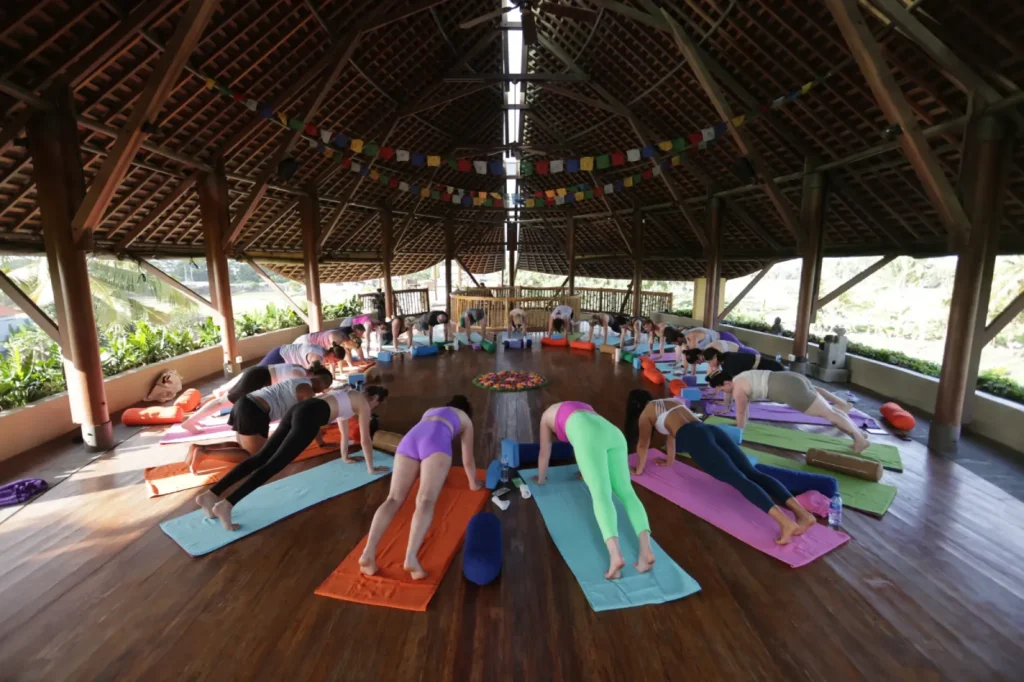
Before you commit to any venue, you need a straight answer on room configuration, yoga and movement space, spa capacity for group treatments, and whether the dining setup can actually seat your group together rather than in shifts.
Floating Leaf’s Facilities and Rooms pages cover the layout, and if you’re planning a larger program, the Corporate Retreat page addresses bigger-group logistics specifically.
What Kinds of Retreats Does This Actually Work For?
The eco-and-community setup suits different program formats differently:
- A corporate wellness offsite gets a genuine ESG story it can point to afterward, not a greenwashed one.
- A yoga teacher-led retreat gets grounding in a place with real spiritual and cultural weight behind it, rather than a studio dropped into a resort.
- A slower, personal-growth format like a Path to Happy Retreat benefits from a setting that isn’t performing wellness for the cameras.
- A larger group retreat still gets the same land history and community ties at scale.
Which format you’re running should shape how hard you lean on the eco angle in your own marketing.
How Does Floating Leaf Support Retreat Leaders Specifically?
An eco-conscious venue is only half the decision — the other half is whether the property actually helps you fill and run the retreat once you’ve booked it. Floating Leaf’s Host a Retreat program and retreat builder tool exist for exactly that: planning support, logistics coordination, and a dedicated concierge rather than a venue that hands you the keys and disappears.
If you’re earlier in the planning process, 7 Simple Steps to Host a Retreat in Bali and How to Fill Your Bali Retreat: A 90-Day Booking Plan walk through the costs and booking timeline in more depth than this post has room for.
Does an Eco Venue Cost More, or Save You Money?
It’s a fair assumption that “eco” means “expensive,” but the economics usually run the other way for a retreat leader. Locally sourced meals are frequently cheaper and fresher than importing ingredients to satisfy a Western menu, and a venue with a genuine community relationship tends to need less external vendor coordination on your end — fewer outside caterers, transport companies, and activity providers to separately vet and manage.
The real cost conversation isn’t “eco versus not,” it’s the hidden line items that show up at any venue, covered in more depth in the cost and logistics post linked above.
How Does This Compare to a Typical Bali Resort?
Part of vetting any eco retreat venue is being honest with yourself — and later with your participants — about what it isn’t. Floating Leaf doesn’t lead with in-room TVs, nightlife proximity, or a beachfront address, on purpose. That’s a deliberate trade against a standard resort stay, and it’s worth setting the same expectation with your own participants up front rather than letting them assume five-star means “resort as usual.”
The Is Floating Leaf Right for You page lays out that distinction directly, and borrowing its honesty in your own retreat marketing tends to reduce mismatched bookings and post-retreat complaints.
What Should Be on Your Checklist Before You Book Any “Eco” Venue?
Before you sign with any venue marketing itself as eco-conscious, ask for:
- The land’s history and its actual relationship to the local community
- Where meals are sourced and how dietary needs get handled at group scale
- The split between local and outside staff
- Concrete water and energy practices rather than a mission statement
- Reviews you can verify independently rather than testimonials curated on the venue’s own site
Not sure if Floating Leaf fits your retreat’s footprint and your guest list? A free 30-minute consultation is the fastest way to find out. Schedule a Free Consultation or Start Designing Your Retreat.
Frequently Asked Questions
Is Floating Leaf certified by a specific eco-certification body?
Floating Leaf doesn’t hold a specific third-party eco-certification, like Green Globe or EarthCheck. Its sustainability case rests on verifiable specifics instead: land history, local sourcing, and community employment, detailed on the Sustainability page.
How many people can Floating Leaf host for a retreat?
Capacity depends on room configuration and program format. See Facilities and Rooms for the layout, or ask directly during a consultation for a number that fits your specific group.
Is Floating Leaf better suited to a small group or a large one?
The property handles both personalized retreats and larger group programs, including corporate retreats — the right fit depends on your program’s format and how much shared versus private space you need.
Does Floating Leaf help fill the retreat, or just provide the venue?
Both. Beyond the physical space, the retreat builder and host-a-retreat program are built to help with planning and logistics — see the 90-Day Booking Plan post for how that works in practice.
Does the sustainability commitment cover the whole stay, or just the food?
It extends beyond meals to staffing, land use, and community relationships, covered in more depth on the Sustainability and Community pages.
Will an eco-focused venue feel less luxurious to my participants?
Not necessarily — eco and luxury aren’t opposites here, they’re separate questions. See the companion post on what a luxury retreat center in Bali should actually deliver if comfort is a bigger concern for your group.
See it before you commit. Walk through the property on the Virtual Tour, then schedule a free consultation to talk through your group’s specific needs.
Want to host your retreat in a quieter corner of Bali? Our free Retreat Planning Guide shows how to pick the right region for your group.