
We hear a version of “which yoga center is best for a retreat in Bali” often, usually from a teacher who has led beautiful sessions for years but never had to book the venue itself. It’s a fair question, and most of what you’ll find answering it online is written for someone looking to attend a retreat, not host one. Those are genuinely different questions. A guest wants a good class and a comfortable room. You need a space that can actually hold your group, support your program, and help you look good in front of the people who trusted you enough to show up. So we’ll answer this honestly, criteria first, including where another property might simply be the better fit for what you’re planning.
- 1 What Does “Best” Actually Mean When You’re the One Hosting, Not Just Attending?
- 2 How Does Floating Leaf Compare to Ubud’s Best-Known Yoga Studio Brand?
- 3 How Does Floating Leaf Compare to an Intimate Luxury Boutique Property?
- 4 What Should You Actually Check in a Yoga Shala Before You Book It for Your Group?
- 5 Does Group Size Change Which Venue Is Actually “Best”?
- 6 What Else Matters Beyond the Yoga Space Itself?
- 7 So Which Yoga Center Is Actually Best for Hosting a Retreat in Bali?
- 8 Frequently Asked Questions
What Does “Best” Actually Mean When You’re the One Hosting, Not Just Attending?
For a guest, best means atmosphere, a good teacher, a nice space for an hour. For you, as the one hosting, best means something closer to infrastructure: a shala sized for your actual group, a venue that’s genuinely set up to welcome outside leaders rather than one that only runs its own programming, a team who can carry the logistics around your sessions so you can focus on teaching, and a booking process that doesn’t leave you guessing whether hosting is even possible there. Most “best yoga Bali” content never asks this second question. We think it’s the one that actually matters to you.
How Does Floating Leaf Compare to Ubud’s Best-Known Yoga Studio Brand?
One of the best-known names in Ubud is a large, well-established yoga studio brand, and for a guest booking its own signature retreats or classes, that recognition is well earned. For you, bringing your own group and running your own program, the picture is less clear. Studios like that typically describe their own retreats and a packed class schedule, but say nothing about hosting outside leaders or groups, no shala capacity, no group-booking terms, nothing that tells you this is a path they’re built for. Welcoming outside retreat leaders is simply what we built Floating Leaf to do. Our Host a Retreat program and retreat builder exist so you can bring your group and run your own agenda, with a dedicated concierge carrying the logistics around it.
How Does Floating Leaf Compare to an Intimate Luxury Boutique Property?
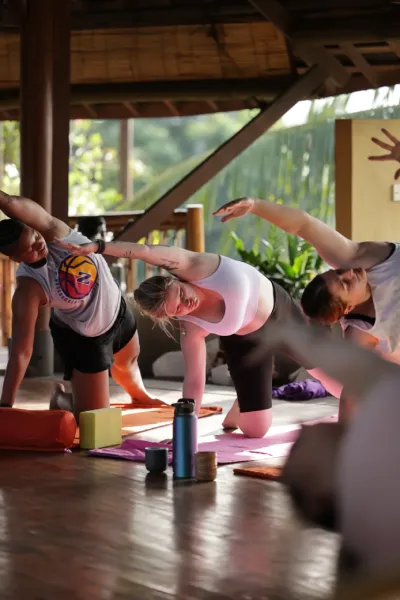
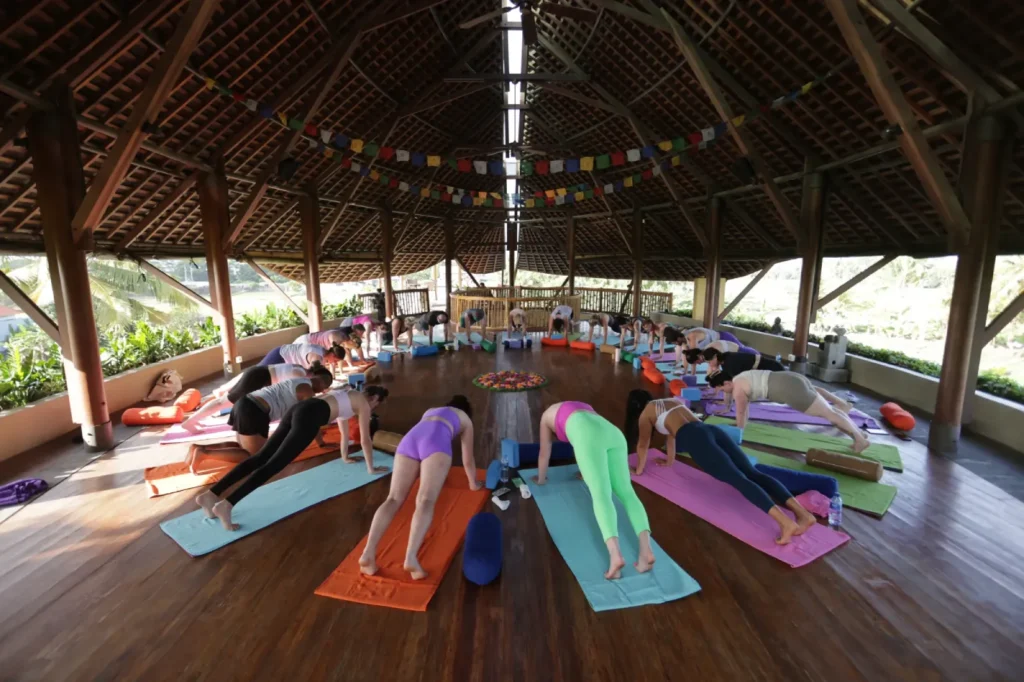
At the other end of the spectrum, you’ll find small, intimate luxury properties built around exclusivity rather than group hosting, private pools, a handful of suites, and a philosophy centered on one or two guests at a time rather than a full retreat group. That kind of property is genuinely beautiful, and its luxury is real and well deserved, but it’s built around intimacy at a scale that works against most retreat formats: suites sleeping two to four people each, with the whole experience framed as an intimate retreat rather than a group-hosting venue. A dedicated yoga shala usually isn’t part of that picture either, yoga reads as a feature of the stay rather than the backbone of a program. If your retreat needs ten, twenty, or thirty people sharing a real practice space, that’s simply a different kind of venue. Our own Yoga Sanctuary is a 2,000-square-foot, open-air shala built to hold up to 30 participants, with panoramic coastline views and sunrise or sunset practice on the beach when you’d like it, built for your group, not as a boutique amenity.
What Should You Actually Check in a Yoga Shala Before You Book It for Your Group?
Ask for the actual square footage and a stated maximum capacity, not just photographs. A beautiful shala that seats twelve comfortably is the wrong room for a group of twenty-five. Ask whether the space is indoor, outdoor, or open-air, it changes both the feeling of the practice and what happens to your schedule if it rains. Ask what equipment is actually provided, mats, props, a sound system, versus what you’ll need to bring yourself. And ask plainly whether the venue has hosted outside retreat leaders before. A property with no real track record of outside hosting is a bigger unknown than one that does this as a matter of course.
Does Group Size Change Which Venue Is Actually “Best”?
Quite a bit, honestly. A solo teacher bringing six participants for an intimate, personal-growth format might genuinely be better served by a smaller, more private property built around that kind of scale. A teacher or studio bringing fifteen to thirty people for a structured program needs a venue built for that scale: a real shala, real group dining, real program space, which is where we believe Floating Leaf is actually strongest. Neither kind of venue is better across the board. The honest answer to “which is best” depends entirely on how many people you’re bringing and what you’re running.
What Else Matters Beyond the Yoga Space Itself?
The shala is the most visible piece, but it’s rarely what makes or breaks your experience as the one hosting. Dining that can handle your group’s dietary needs at scale, rooms that don’t create friction between participants, a team that actually coordinates logistics around you rather than handing you the keys and disappearing, and a track record you can point to when you’re marketing the retreat to your own audience, all of that matters just as much as shala square footage. We’re proud that Floating Leaf has held a TripAdvisor Travelers’ Choice award every year since 2014, alongside press placements in Forbes, Vogue, and Conde Nast Traveller, the kind of independently verifiable credibility you can use directly in your own sales conversation. It’s worth asking any venue you’re considering to show you the same, not just claim it.
One of our specialties, in a retreat leader’s own words. Stella Tyron, who runs retreats through Stella Luna School, told us after her own program here that our kitchen team reworked its entire approach around her group’s specific dietary needs, flexibility she said she hadn’t found at other venues. We don’t take that lightly. Being able to actually rework a kitchen’s workflow around a group, rather than offering a fixed menu with a few substitutions, is exactly the kind of thing we consider one of our specialties.
So Which Yoga Center Is Actually Best for Hosting a Retreat in Bali?
Honestly, it depends on what you’re running. If you want Ubud’s most recognized yoga studio name and you’re not bringing and managing your own outside group, that kind of studio’s own programming is hard to beat. If you want boutique, private luxury for a very small group, an intimate luxury property delivers that beautifully. And if you’re a retreat leader who needs to bring your own group, run your own program, and have a venue genuinely built to support that, sized shala, real hosting infrastructure, a track record you can verify, we built Floating Leaf for exactly that, rather than stretching a guest-facing property to fit.
Want to see if the shala and the support actually hold up for your group size? Schedule a Free Consultation or Start Designing Your Retreat to talk specifics.
Frequently Asked Questions
What’s the actual capacity of Floating Leaf’s yoga shala?
The Yoga Sanctuary is 2,000 square feet and can host up to 30 participants, with sunrise or sunset beach practice available as an alternative setting.
Does Floating Leaf work with independently certified yoga teachers, or only its own staff?
Outside retreat leaders bring and run their own programs, Floating Leaf’s role is providing the venue, shala, accommodation, dining, and logistics support around it. If credentialing matters to your own marketing, Yoga Alliance’s teacher resources covers what RYT and related credentials actually verify.
Can a smaller group of 6 to 10 people still book Floating Leaf, or is it only for larger retreats?
Yes, the venue accommodates a range of group sizes, though its shala and program infrastructure are specifically built to also support larger groups up to 30, which is where it differentiates most clearly from smaller boutique properties.
Can I Get References From Other Retreat Leaders, Not Just Guest Reviews?
Yes, ask for them directly. Guest reviews tell you about the stay, but a reference from someone who’s actually run a retreat there tells you whether the venue delivers on logistics, communication, and support once your group arrives. If a property can’t produce one, that’s worth noting before you book.
How does pricing compare between these venues?
Pricing structures aren’t directly comparable since the properties serve different use cases and group sizes, request a quote based on your specific group size and program format from each venue you’re considering.
What’s the single most important thing to verify before booking any venue for a retreat I’m hosting?
Whether the venue has an actual track record of hosting outside retreat leaders, ask for it directly, and treat a lack of any stated group-hosting program as a real signal, not just missing marketing copy.
See the Yoga Sanctuary and the rest of the property for yourself. Walk through the Virtual Tour, then schedule a free consultation to talk through your group’s specific needs.